JavaScript AI Build-a-thon 2026
Agile Sprint
Orchestrator
We don't track sprints. We predict and optimize them.
Teams lose 30–40% of sprint effort due to poor planning and overcommitment. This system prevents that — before the sprint even begins.
An AI system that predicts sprint failure before it happens — and autonomously fixes it. Five specialized agents. Seven phases. One intelligent pipeline that learns from every sprint.
Sprints Don't Fail at the End — They Fail on Day 1
By the time a sprint looks “at risk,” it's already too late. The data to prevent failure exists — but nothing connects it.
Backlog Chaos
Tickets enter sprints without acceptance criteria, estimates, or dependency mapping. Teams discover missing requirements mid-sprint.
Planning by Gut Feel
Nobody connects actual capacity to historical velocity. Result: 30-40% spillover rates, every sprint.
Invisible Quality
"Done" doesn't mean "done right." Work product quality is a mystery until the review demo.
Sprint Amnesia
Every sprint starts from zero. The retro insights from three sprints ago? Gone. Same patterns repeat for months.
The Idea
What if every Agile ceremony had a dedicated AI agent — and a central brain coordinated all of them into a learning system?
Five agents. Seven phases. One intelligent pipeline.
System Architecture
A human-in-the-loop multi-agent system combining local AI, cloud intelligence, and cross-sprint memory.
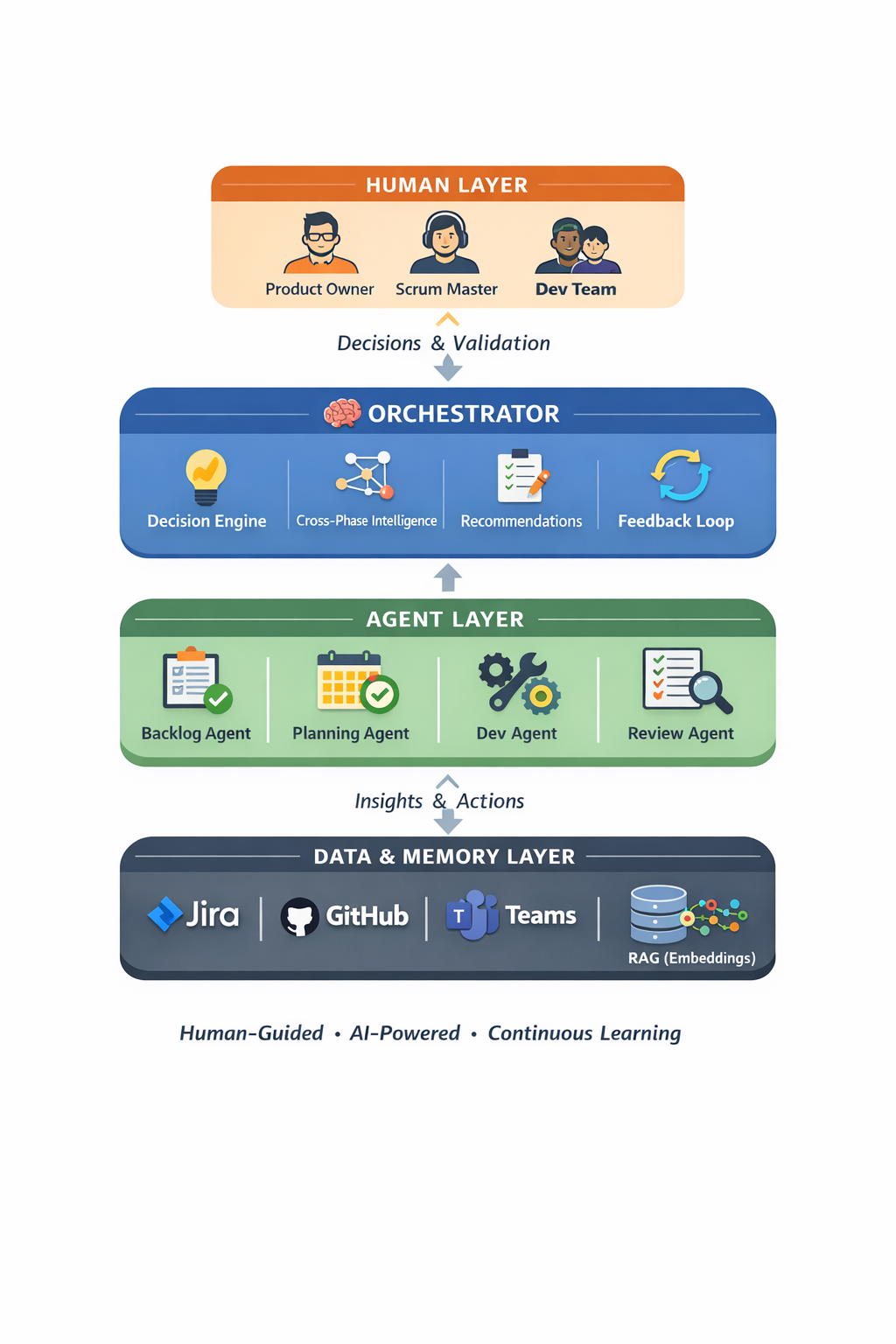
Orchestrator
Central brain coordinating all agents through a 7-phase pipeline. Maintains cross-sprint memory, detects cross-phase correlations, and generates intelligence reports with an AI Manager layer.
What Each Agent Does
Each agent is an independent service with its own API, dashboard, and specialized intelligence.
Backlog Agent
:3000For the Product Owner
Refines raw requirements into sprint-ready tickets. Validates schema, estimates story points, detects dependencies, flags risks.
Planning Agent
:3020For the Scrum Master
Builds optimal sprint plans within team capacity. Uses historical velocity + RAG to prevent overcommitment.
Dev + Standup Agent
:4040For the Team
Processes standup transcripts, extracts blockers, evaluates work products against acceptance criteria using rule-based evaluation.
Review + Retro Agent
:5050For PO and Scrum Master
3-layer evaluation pipeline (Rule Engine + Foundry Local + Azure OpenAI). Data-driven retrospectives with pattern detection.
The Orchestrator
:6060The Brain
Coordinates all agents through 7 phases. Maintains cross-sprint memory, detects cross-phase correlations, generates intelligence reports.
Sprints That Learn
Most tools treat each sprint as isolated. We don't. After every cycle, the orchestrator persists what happened — which tickets spilled over, which retro items were never addressed, how estimates compared to actuals. The next sprint automatically consumes this context.
“After 3 cycles, the system suggested reducing capacity by 15% because historical data showed consistent overcommitment. No human asked for this. The memory surfaced it automatically.”
The Moment It Clicked
During testing, the system flagged a sprint as “high risk” — before it even started.
No bugs. No blockers. Just one silently overloaded developer.
We redistributed work. The prediction changed.
That's when it became clear: this isn't automation. This is decision intelligence.
Not tracking work — deciding outcomes.
Sprint Risk Intelligence
Before execution begins, the system generates a Sprint Risk Score (0–100) — converting complex sprint signals into a single, actionable decision.
Risk Score: 72
HIGH — Sprint needs intervention
150%
Developer overload
3
Unresolved dependencies
+25%
Spillover trend
Recommendation
Reduce scope by 20% or rebalance workload across team members.
“Is this sprint going to fail — before it even starts?”
Responsible AI
Built in, not bolted on. Every AI decision is transparent, safe, and auditable.
Transparency
Every output lists its data sources (RuleEngine, FoundryLocal, AzureLLM, RAG) and a confidence score (0-100). Nothing is a black box.
Safety & Accountability
Input sanitization, rate limiting at 60 req/min, RBAC with 3 roles. Per-agent audit logs. Responsible AI Dashboard.
Offline Mode
One toggle switches to Foundry Local + Ollama. Zero data leaves the machine. Critical for sensitive sprint data.
Tech Stack
Try It Yourself
git clone https://github.com/snehasankaran/agile-sprint-orchestrator.git
cd agile-sprint-orchestrator
npm install
cp .env.example .env # Add your API keys
# Start all 5 services
node backlog_agent_final.js # :3000
node sprint_planning_agent.js # :3020
node iterative_standup_agent.js # :4040
node review_agent.js # :5050
node orchestrator.js # :6060
Open http://localhost:6060 and click Run Full Cycle.
Why This Stands Out
Decision Intelligence
Converts complex sprint data into clear, actionable decisions (risk score, recommendations)
Autonomous Execution
AI runs all 7 sprint phases end-to-end
Cross-Sprint Memory
Every sprint learns from the last
Hybrid AI
Cloud (Azure) + Local (Foundry) in one system
Responsible AI
Transparency, auditing, and offline mode built in
MCP Protocol
11 tools accessible from VS Code, Copilot, Claude
Action Capabilities
Not just analysis — our agents take real action on external systems.
Push to JIRA
Refined backlog tickets and sprint plans are pushed directly to your JIRA board via REST API.
Fetch from JIRA
Live board, sprint, and ticket data pulled in real-time for planning and review.
MS Teams Transcript Parsing
Standup insights extracted from Microsoft Teams meeting transcripts via Graph API.
Monte Carlo Prediction
10,000-iteration simulation forecasts sprint completion probability from historical velocity.
Cross-Sprint Memory
Retro actions and patterns persist across sprints and auto-feed into next planning cycle.
Responsible AI Guardrails
Every LLM output is validated, PII-scanned, confidence-scored, and audit-logged.
Quests Integrated
Azure OpenAI (GPT-4o)
LLM-powered evaluation, sprint planning, and intelligence reports via LangChain.js
Foundry Local (phi model)
On-device AI for privacy-first ticket extraction and analysis. Zero data leaves the machine.
Ollama Embeddings
RAG vector store (nomic-embed-text) for context-aware decisions using historical sprint data
MCP Server
11 tools exposed via Model Context Protocol for VS Code, GitHub Copilot, and Claude Desktop
Azure Developer CLI + Bicep
Infrastructure-as-code deployment to Azure Container Apps with azd
GitHub + MS Graph APIs
Work product fetching from GitHub, Teams transcript ingestion via Microsoft Graph
Built With AI
Real prompts. Real workflows. Built with GitHub Copilot for early scaffolding and rapid prototyping, then Cursor (Claude) for deep architecture and debugging.
Architecture decision
“You're comparing HTTP Orchestrator vs LangGraph. What do you recommend?”
AI recommended enhancing the existing HTTP orchestrator instead of rewriting -- saving days of work.
Feature addition
“Add intelligence report feature, retry, memory enhancements, AI Manager”
AI broke this into 4 tasks and implemented each with retry logic, circuit breakers, and cross-sprint memory.
Bug diagnosis
“Can we have all use cases why is it 0 completion. Realistic data shall help to show the demo”
AI traced the root cause to a JavaScript falsy-value bug (|| vs ??) and expanded simulated data.
UI consistency
“GUI is inconsistent between main GUI and sub agents GUI? Dark theme to match the orchestrator”
AI systematically updated all 4 agent HTML/CSS and app.js files to match the orchestrator theme.
Security cleanup
“Don't store any secrets like tokens, better folder structure”
AI found hardcoded credentials in 6 files, replaced with env vars, created .env.example and .gitignore.
What worked: Small, focused prompts with clear context. What didn't: Large “build everything” prompts that needed significant rework.
Most Agile tools tell you what happened.
This system tells you what will happen — and what to do about it.
Watch It In Action
From backlog to intelligence report — fully automated, in under 5 minutes.